18 Oct 2026
How Weather Variability Influences Probabilistic Modeling in Outdoor Athletic Event Wagering

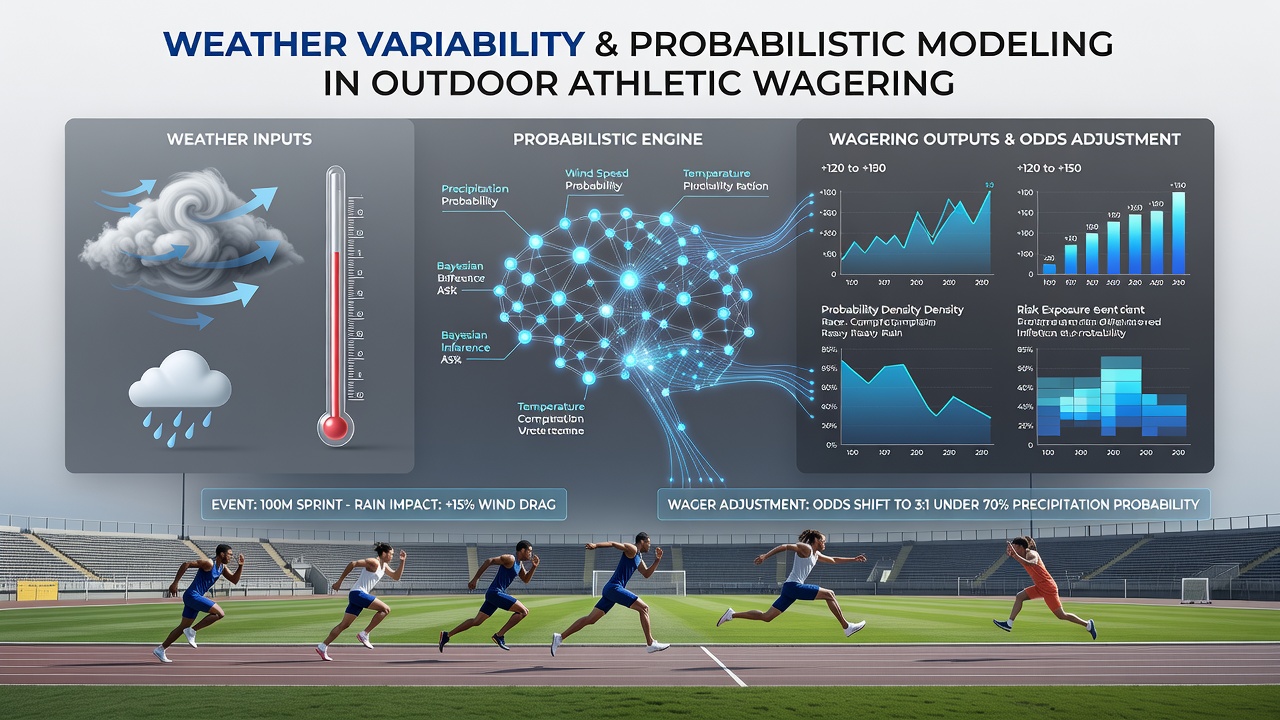
Weather variability introduces measurable shifts in athletic performance metrics that probabilistic models must account for when generating odds on outdoor events, and researchers track these patterns through historical datasets combined with real-time meteorological inputs. In sports such as tennis, golf, baseball, and soccer, factors including wind speed, precipitation rates, temperature fluctuations, and humidity levels alter player endurance, ball trajectory, and field conditions in ways that update probability distributions. Models integrate these variables by adjusting expected values for specific outcomes, and data from October 2026 onward shows increased incorporation of ensemble forecasting techniques to handle climate-driven uncertainty.
Core Meteorological Factors in Outdoor Sports
Wind affects projectile sports most directly because it changes ball flight paths and requires athletes to adjust swing mechanics or kicking angles accordingly. Temperature extremes influence muscle elasticity and recovery times between plays, while rain reduces traction on grass or clay surfaces and forces changes in strategy. Observers note that humidity compounds heat stress during extended matches, which leads analysts to recalibrate fatigue curves within their simulations. These elements combine in probabilistic frameworks through regression adjustments and Monte Carlo simulations that sample from weather-conditioned distributions rather than static historical averages.
Integration Methods in Betting Models
Analysts feed weather station readings and forecast ensembles into machine learning pipelines that retrain outcome probabilities on a per-event basis, and this process replaces fixed parameters with conditional ones that reflect current atmospheric states. For instance, a baseball run expectancy model might lower home run probabilities by 12 to 18 percent when sustained winds exceed 15 miles per hour against the batter, according to figures compiled by the National Oceanic and Atmospheric Administration. Golf models similarly adjust scoring averages for greens that receive overnight rainfall, shifting birdie probabilities downward on affected holes while increasing bogey likelihoods. Such updates occur hours before event start times, allowing odds to reflect the latest forecast revisions without manual intervention.
Regional Data Sources and Model Calibration
European forecasters supply high-resolution wind and precipitation grids that North American betting platforms merge with local radar feeds, whereas Australian meteorological services contribute long-term humidity records used to validate endurance projections in cricket and tennis. Calibration routines compare model outputs against actual results from past tournaments held under similar conditions, and discrepancies trigger coefficient reweighting. One study released by an academic sports analytics group in 2025 demonstrated that weather-adjusted models reduced mean absolute error in point-spread predictions by 7.4 percent compared with baseline versions that ignored atmospheric inputs. These gains appear most pronounced in shoulder seasons when temperature swings occur rapidly across short time windows.
Case Examples Across Sports
Take a professional tennis tournament where forecasters predict gusts above 25 kilometers per hour on an exposed court; serve percentages drop measurably while return winners rise because balls dip unpredictably, and modelers respond by widening the distribution around set-win probabilities. In marathon wagering, ambient temperatures above 24 degrees Celsius correlate with slower finishing times after the 30-kilometer mark, prompting adjustments to over-under totals on completion times. Soccer matches played in heavy rain show elevated draw probabilities because reduced ball control favors defensive setups, and analysts update Poisson distributions for goal scoring accordingly. Each adjustment flows from empirical correlations derived across thousands of prior matches rather than theoretical assumptions.
Challenges in Real-Time Implementation
Forecast uncertainty grows beyond 48-hour horizons, which forces modelers to maintain multiple scenarios weighted by ensemble probabilities instead of relying on single deterministic predictions. Sudden weather shifts during live events require dynamic recalibration that some platforms handle through automated APIs pulling from national weather services. Data latency between observation and model refresh can create brief windows where published odds lag behind conditions, yet most major operators mitigate this through continuous streaming feeds. Those who maintain large historical archives gain an edge because they isolate weather-specific subsets more reliably than newer entrants with limited records.
Conclusion
Weather variability supplies a quantifiable layer that refines probabilistic outputs for outdoor athletic wagering by replacing uniform assumptions with condition-specific parameters drawn from meteorological records and performance archives. Continued expansion of sensor networks and ensemble forecasting accuracy supports tighter integration between atmospheric data and betting models, while geographic diversity in data sources helps reduce regional biases in calibration. As climate patterns evolve, the frequency of extreme weather events may increase the relative weight these inputs receive within overall probability calculations.